Auto Repair Shop · n8n Workflow Automation
Auto Repair — Estimate Approval and Service Reminder
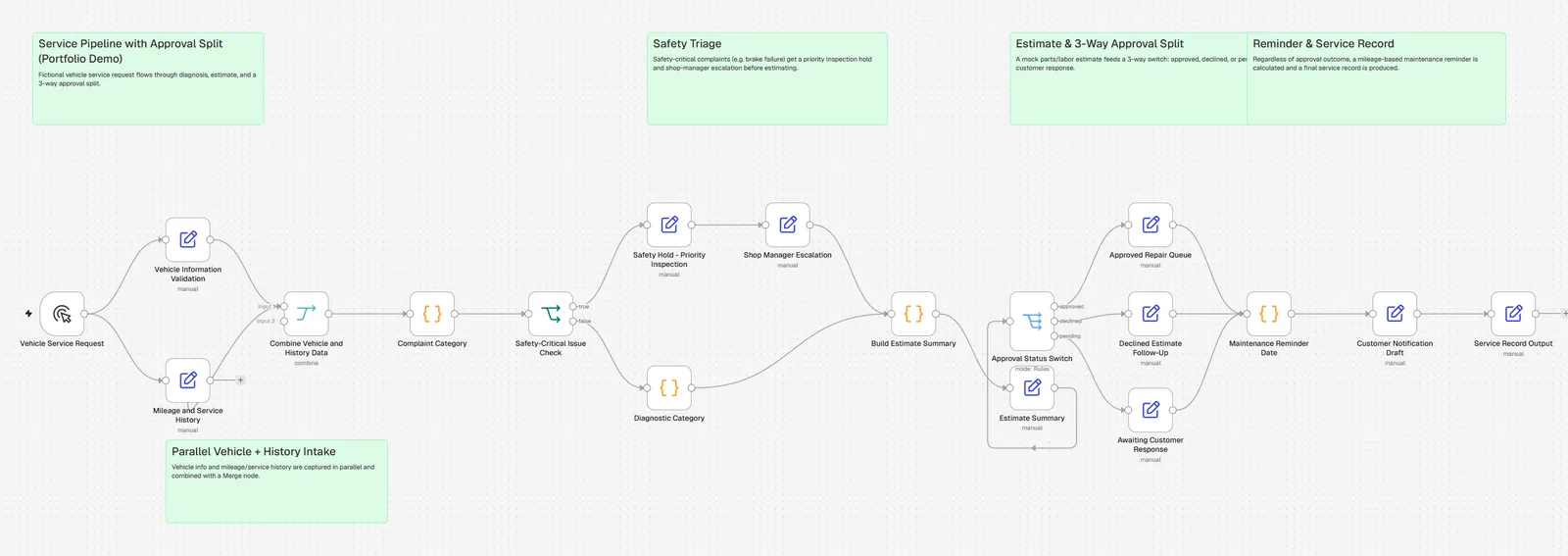
Portfolio DemonstrationVehicle and service-history data are captured in parallel and merged before a keyword-based complaint classifier and safety check determine whether the item gets a priority inspection hold; a mock cost-table estimate then drives a 3-way approval split, with every outcome producing a mileage-based maintenance reminder.
Problem
Shops lose time chasing customers for estimate approvals and manually tracking service reminders.
System Design
Service pipeline with approval split: parallel intake merges into a linear diagnostic/estimate pipeline, ending in a 3-way approval switch (approved/declined/pending).
Workflow Stages
- 01Parallel Vehicle + History Intake
- 02Safety Triage
- 03Estimate & 3-Way Approval Split
- 04Reminder & Service Record
Tools Used
- n8n
- Code (JavaScript)
- If
- Manual Trigger
- Merge
- Set
- Switch
Safety & Human Review
- Workflow name begins with DEMO | and is inactive.
- No credentials are attached to any node.
- No enabled external send node exists anywhere in this workflow.
- All data is fictional (example.com emails, invented names/addresses).
- Uses only built-in n8n node types.
Implementation Evidence
Real screenshots of the working system — collapsed by default so this page stays readable.
What's Working
7 structural checks passed, including: Workflow JSON parses (local + server-returned copy); active is false; Name begins with DEMO |; No credentials attached to any node. Structural and logic validation completed. Live n8n execution pending manual safe test.
Limitations & Confidentiality
Classification and scoring logic is deterministic/rule-based rather than a live AI model, by design (provider-independent, fully inspectable, no credential required). No real system of record, messaging channel, or calendar is connected - every downstream action is simulated or drafted, never sent. Live n8n execution has not been triggered as part of this build.
Portfolio demonstration built for a fictional business with fictional data. It is not connected to any real client, system, or customer.
What I'd Improve Next
Replace deterministic classification with a real AI model behind the same confidence/human-review pattern where one exists. Connect the mock/simulated steps to real systems of record once reviewed and approved. Wire a real (approved) communication channel behind the draft-message steps.
Have a similar workflow to automate?
I'll tell you honestly whether automation is the right fix.